Why We Lose Attention So Easily
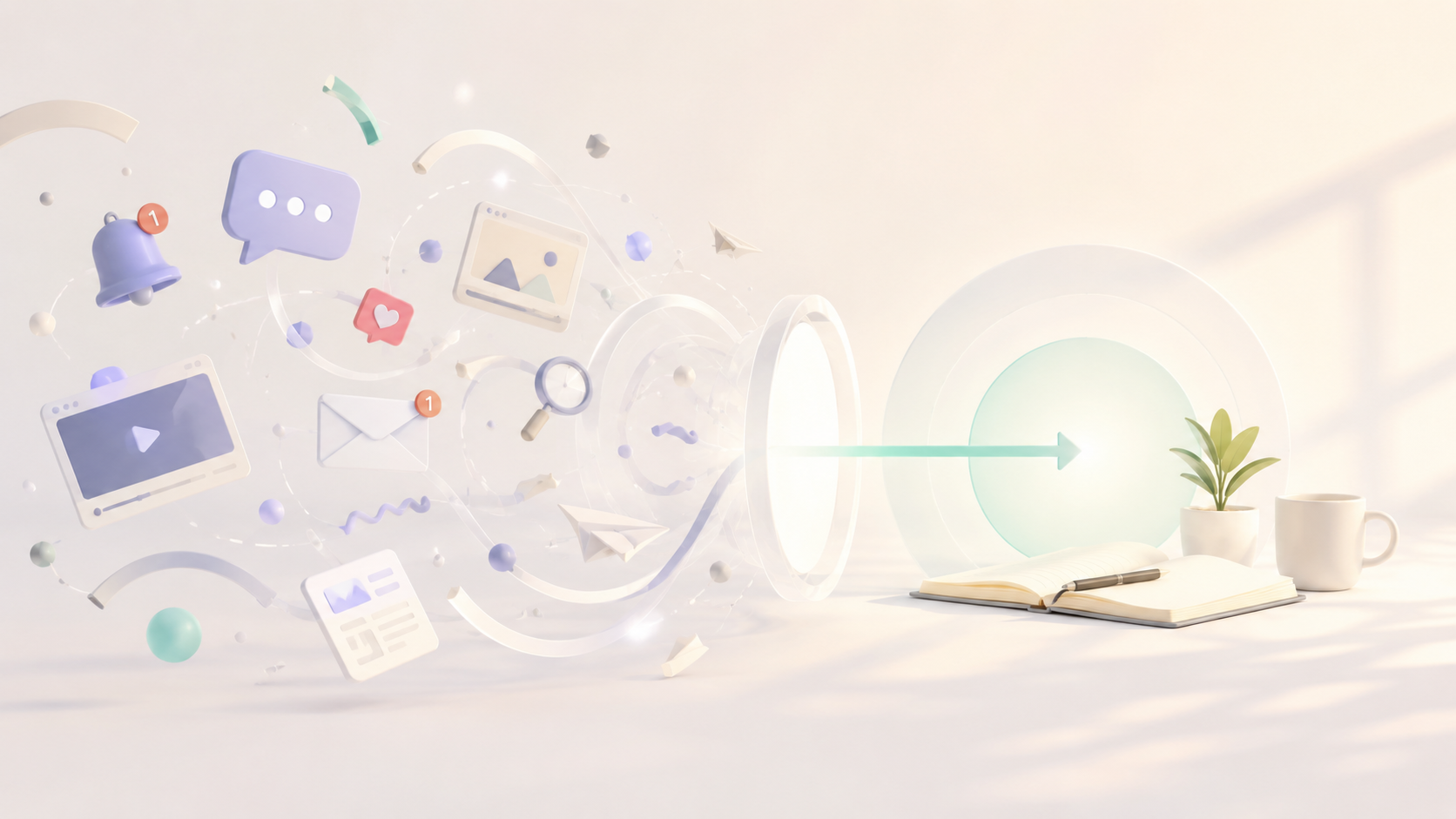
Losing attention can feel random. One moment you are working, and the next moment you are checking a message, opening a new tab, watching a tutorial, thinking about another idea, or suddenly remembering something completely unrelated.
It feels like your brain simply wandered away. But most of the time, attention does not disappear for no reason. It gets pulled. Something becomes more interesting, less uncomfortable, easier to start, or more rewarding than the task you originally chose.
That does not mean you are lazy. It means your attention is constantly being negotiated between what matters, what feels easy, what feels urgent, and what feels exciting right now.
Attention is not just about focusing harder. It is also about understanding what keeps stealing the focus.
Your brain likes novelty
New things feel interesting. A new tab, a new message, a new idea, a new video, a new tool, or a new notification can all feel slightly more exciting than the task you already chose. Even when the task is important, it may not give your brain an instant reward.
Important work often requires staying with one thing longer than your brain naturally wants to. Writing the next paragraph, fixing a bug, studying a chapter, editing a timeline, finishing a design, or shipping a feature usually asks for patience before it gives you satisfaction. Novelty, on the other hand, gives your brain a quick spark immediately.
That is why the escape often starts small. You tell yourself you are just checking one thing, opening one tab, watching one short video, or reading one quick explanation. The cost is not obvious at first. But after a few minutes, the original task feels further away than it should.
Hard tasks create friction
Attention often breaks when the task becomes uncomfortable. Maybe the next step is unclear. Maybe the task feels too large. Maybe you are afraid the work will not be good enough. Maybe you are tired. Maybe you know exactly what to do, but starting still feels strangely heavy.
That friction creates an opening. Your brain starts looking for something easier, and the replacement task does not always look lazy. Sometimes it looks useful. You avoid writing by researching writing advice. You avoid coding by reorganizing your project. You avoid studying by making a perfect study plan. You avoid posting by studying other people’s posts.
The replacement task feels productive because it has less emotional weight. It gives you motion without forcing you to face the harder part of the work. That is why losing attention is not always about wanting entertainment. Sometimes it is about wanting relief.
A lot of distraction is not a search for fun. It is a search for relief.
Your environment is built to interrupt you
Modern work usually happens inside devices that are designed to pull attention in every direction. Your browser has endless tabs. Your phone has endless apps. Every platform has alerts, badges, previews, recommendations, messages, and feeds waiting for you.
Even when you ignore a notification, it can still leave a tiny mental hook. You start wondering who messaged you, whether it was important, or whether you should just check quickly and come back. The interruption may last only a few seconds, but the recovery often takes longer.
This is the part people underestimate. The problem is not only that something interrupted you. The problem is that your attention has to rebuild itself after every interruption. You may return to the task physically, but your mind can still be halfway inside the thing that pulled you away.
Vague tasks make attention leak
A vague task is hard to focus on because your brain does not know where to land. “Work on the project” sounds productive, but it does not tell you what to do next. “Study properly” sounds responsible, but it does not give your attention a clear starting point. “Make progress” sounds good, but it is too blurry to act on.
When the task is too broad, your brain keeps scanning for something more concrete. That is why a tiny, clear action often works better than a big motivational plan. “Open the file and fix the button spacing” is easier to return to than “work on the app.” “Read two pages” is easier to return to than “study.” “Write the first rough paragraph” is easier to return to than “finish the article.”
Attention likes a landing point. The clearer the next action is, the easier it becomes to return.
Unfinished loops keep pulling at you
Sometimes you lose attention because another unfinished thing is still open in the background. A message you forgot to reply to. A bug you still need to fix. A payment you need to check. A random idea you do not want to forget. A tab you left open yesterday. A future task that suddenly comes back into your head.
These unfinished loops create mental noise. Your brain keeps trying to hold them while also doing the current task, and that makes the current task harder to stay with. This is why writing things down can help. Not because notes magically solve everything, but because they give your brain permission to stop carrying every open loop at once.
So how do you manage it?
You do not need to become a perfect focus machine. A better goal is to build a simple return system. When the task feels too big, shrink it until it becomes startable. Instead of trying to finish the whole project, open the file. Instead of trying to write the full article, write one rough line. Instead of trying to study the entire chapter, read one section.
When a side thought appears, do not spend ten minutes fighting it. Capture it somewhere safe and return. The goal is not to delete every side idea. The goal is to stop every side idea from becoming the main task.
It also helps to make distraction slightly harder to reach. Keep the phone away for one sprint. Close tabs that are not part of the task. Mute non-urgent notifications. Use full screen when writing, studying, designing, or coding. You do not have to redesign your entire life. You only need to reduce the easiest escape routes.
Most importantly, restart instead of spiraling. The worst part of losing attention is often what happens after you notice it. You get annoyed, feel guilty, think the day is ruined, and then the guilt becomes another distraction. Do not turn one lost moment into a lost day.
The skill is not perfect attention. The skill is recovery.
Where SideQuested fits
SideQuested is built around this exact moment: the moment you realize your attention got pulled away. Instead of treating distraction like failure, it treats noticing as progress.
The loop is simple. You catch the side quest, write what pulled you away, remember your Main Quest, choose the smallest next action, and respawn into a short focus sprint.
Not perfect focus. Faster return.
Final thought
You lose attention easily because your brain is human, your work is often uncomfortable, and your environment is full of tiny side quests. That does not mean you are lazy. It means your attention needs a clear place to return to.
So the next time you drift, do not panic. Pause for a second and ask yourself one simple question.
What is the smallest next action that brings me back?
Got sidequested while reading?
SideQuested helps you notice the drift, respawn, and get back to your Main Quest.

Productive Distraction Is Still Distraction
Not every distraction looks like scrolling reels, watching random videos, or opening social media for no reason.
Read Quest Log